MAGAZINE
MAGAZINE
MAGAZINE
MAGAZINE
By cizucu ·
Cover photo by AinokazeKureha
Photography has always been a technology of reproduction. From the very beginning, prints could be made from negatives, and in the digital era, the same image can be copied infinitely. So, where does the value of a single, unique photograph reside?
The advent of generative AI has further expanded this question. Now, photographic images can be created from words alone, without ever holding a camera. This brings the question of what constitutes an original, and how to maintain uniqueness in an age of infinite reproducibility, back to the heart of photography.
Norbert Schoerner stopped photographing in 2011. Instead, he handed his photographs to anonymous writers on Amazon Mechanical Turk, who described them in words, and then deleted the original images. Only the text remained. Using these texts, he reconstructed the photographs—a practice he continued for twelve years.
This is an attempt to remove the 'original' from photography. The philosopher Walter Benjamin, in his essay 'The Work of Art in the Age of Mechanical Reproduction,' discussed the 'aura' that resides in the uniqueness of the original. He argued that technologies of reproduction, such as photography and film, undermine this aura. Schoerner inverts this paradigm. By intentionally erasing the original, he creates a new kind of presence mediated through language.
Photo by Thomas_J
The year Schoerner stopped photographing, 2011, was a decade before the era when generative AI would 'write' photographs. His practice anticipated how the memory and interpretation of images would transform when humans reduce photographs to language. The subtitle 'Collaborations with Human and Other Minds' now seems to resonate with the presence of AI.
Photographs can be infinitely reproduced. This is precisely why the question of what constitutes the 'authentic' arises. The thirty lifetime-signed prints by Sebastião Salgado, including 'Serra Pelada,' auctioned at Phillips, directly confront this issue.
The image itself can be reproduced. Yet, what holds value in the art market are the artist’s signature, the period when the print was made, its provenance, and traces that indicate it passed through the artist’s hands. In other words, the uniqueness of a photograph is supported not only by its visual content but also by the context of how it has existed.
Photo by ふみ
The more image generation proliferates, the more collectors seek what cannot be reproduced. Although photography is a technology of reproduction, it is increasingly moving toward values that resist replication. The foundation of authenticity is shifting from the image itself to traces of the hand and to provenance.
Scanner malfunctions are typically undesirable. Yet, typowow (YHHY design), a designer based in Beijing and Shenzhen, created a small tool that simulates such malfunctions. According to the designer, this is an unreleased prototype that allows users to set the direction and speed of scanning, drag photographs across the scanner bed, and add noise—making the image appear 'more real.'
Making a damaged image appear authentic is no longer a matter of chance, but of calibration. What once appeared as a one-off accident is now becoming a selectable mode of expression. Malfunctions that were once to be avoided are now effects that can be deliberately invoked.
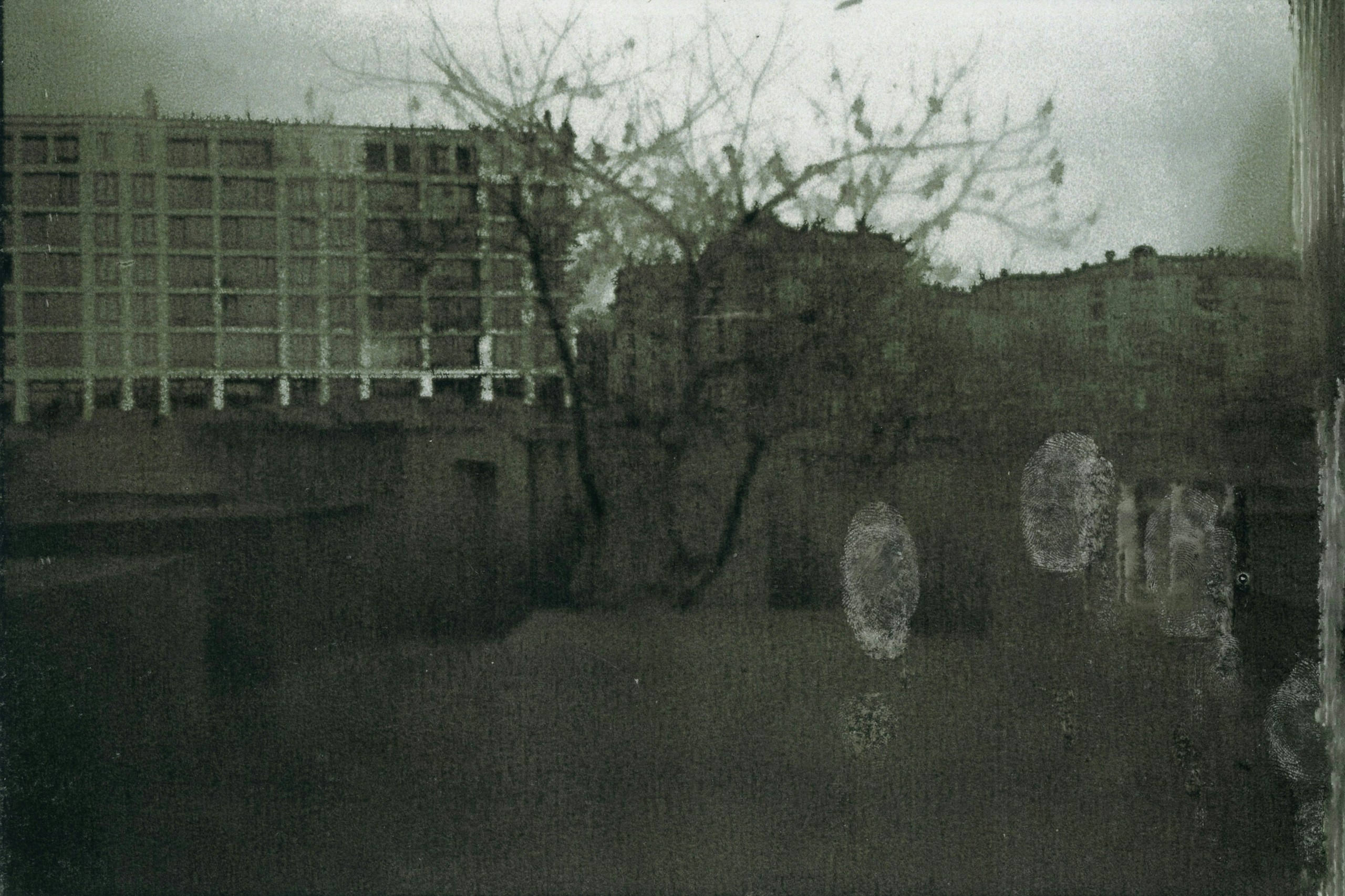
Photo by j_studio08
This, too, reflects a sensibility of the AI era. Generative AI can now replicate film grain, the haze of vintage lenses, scanning glitches, and even accidental blurs. Yet, the moment something becomes reproducible, can it still be considered accidental? In an age where the appearance of chance can be shared, where does the 'singularity' of a photograph remain?
Though these three cases seem distinct, they all address the same question: Where does photographic originality reside?
In an era where images can be generated, reproduced, and manipulated endlessly, uniqueness can no longer be guaranteed by appearance alone. What becomes crucial is the 'context'—who created the image, why, and through what process.
The value of a photograph is not determined solely at the moment the shutter is released. The deleted original, the remaining words, the signature, the provenance, traces of malfunction, and the intention behind these choices—all contribute. In the age of AI, originality may reside not only within the image itself, but also in the accumulated choices and histories surrounding it.
The more reproducibility increases, the more we are compelled to consider 'what cannot be reproduced.' This is why the question of originality in the age of reproduction has been continually revisited since the advent of photography.


